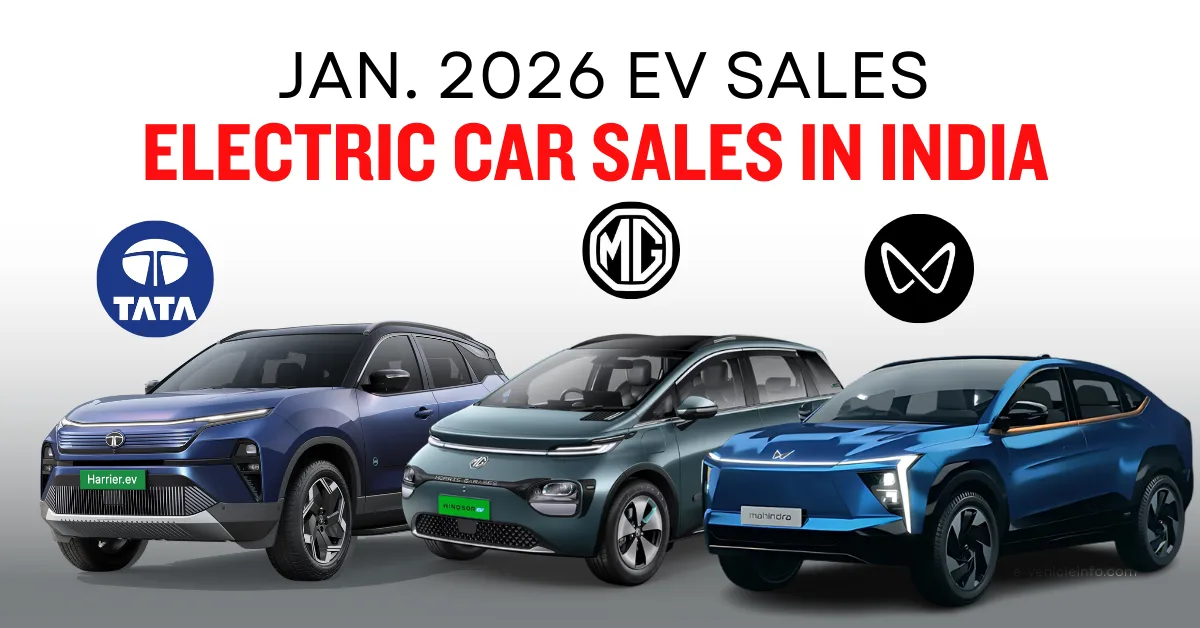
India’s electric four-wheeler (E4W) market began 2026 on a strong footing, registering 18,470 units in January 2026, compared to 11,935 units in January 2025.
This translates into a sharp 54.75% year-on-year (YoY) growth, indicating continued structural expansion in the passenger EV segment.
The January momentum reflects:
-
Improved production stability
-
Strong SUV-led EV demand
-
Wider availability beyond metro cities
-
Growing consumer confidence in EV ownership
The market remains highly concentrated, with the top three players accounting for nearly 89% of total volumes.
Brand-Wise Electric Car Sales Data – January 2026
| Brand | Jan ’25 | Jan ’26 | YoY % | Market Share |
|---|---|---|---|---|
| Tata Passenger Electric Mobility | 5,313 | 8,007 | +50.71% | 43.35% |
| JSW MG Motor India | 4,530 | 4,703 | +3.82% | 25.46% |
| Mahindra Electric Automobile | 740 | 3,668 | +395.68% | 19.86% |
| VinFast Auto India | 0 | 435 | – | 2.36% |
| Hyundai Motor India | 331 | 333 | +0.60% | 1.80% |
| BMW India | 194 | 321 | +65.46% | 1.74% |
| Kia India | 51 | 309 | +505.88% | 1.67% |
| BYD India | 338 | 231 | -31.66% | 1.25% |
| Maruti Suzuki | 0 | 215 | – | 1.16% |
| Mercedes-Benz | 104 | 70 | -32.69% | 0.38% |
| Stellantis (Citroen) | 274 | 41 | -85.04% | 0.22% |
| Tesla India | 0 | 37 | – | 0.20% |
| Volvo Auto India | 29 | 36 | +24.14% | 0.19% |
| Others | 31 | 64 | +106.45% | 0.35% |
| Total | 11,935 | 18,470 | +54.75% | 100% |
Source: Vahan Dashboard, February 2026
#1 Tata Passenger Electric Mobility – 8,007 Units | 43.35% Market Share
Tata.ev continues to dominate India’s EV market with 8,007 units in January 2026, registering 50.71% YoY growth and retaining a commanding 43% market share.
Key volume drivers:
-
Nexon EV – Still the highest-selling electric SUV in India
-
Tiago EV – Strong contributor in the affordable EV segment
-
Harrier EV – Early deliveries supporting premium volumes
Tata benefits from:
-
Extensive dealership and service network
-
Competitive pricing strategy
-
Fleet + retail demand mix
-
Localised manufacturing advantage
The brand remains the clear leader, with sales nearly double that of its closest rival.
#2 JSW MG Motor India – 4,703 Units | 25.46% Market Share
JSW MG Motor India recorded 4,703 units, growing 3.82% YoY. While growth is moderate compared to peers, MG maintains a strong 25% market share, firmly holding second position.
Model contribution:
-
ZS EV – Core mid-size SUV offering
-
Comet EV – Urban-focused compact EV
-
Windsor EV – Contributing fleet and institutional volumes
MG’s growth appears steady rather than aggressive, suggesting demand stability but limited incremental expansion compared to Tata and Mahindra.
#3 Mahindra Electric Automobile – 3,668 Units | 19.86% Market Share
Mahindra delivered one of the most significant jumps in the industry, selling 3,668 units, a massive 395.68% YoY growth.
Major contributors:
-
XUV400 – Established electric SUV
-
BE-series models – Driving new demand
-
XEV 9e platform-based offerings – Gaining traction
The surge reflects improved supply chain stability and aggressive EV positioning. Mahindra is now firmly established as the third pillar of India’s EV market.
#4 VinFast Auto India – 435 Units
VinFast registered 435 units, establishing early traction in the Indian market. With no comparable base in January 2025, YoY comparison is not applicable.
The brand is gradually building dealer presence and consumer awareness, positioning itself in the emerging premium EV space.
#5 Hyundai Motor India – 333 Units
Hyundai recorded 333 units, showing a flat 0.60% YoY growth.
Sales are anchored by:
-
Creta EV
-
Ioniq 5
Hyundai’s EV portfolio remains limited in volume scale, and future launches will be critical to improving market share beyond the current 1.8%.
#6 BMW India – 321 Units | 65.46% YoY Growth
BMW delivered 321 luxury EVs, marking 65.46% growth.
Key models:
-
i4
-
iX
-
i7
BMW continues to lead India’s luxury EV segment, benefiting from strong brand recall and steady premium demand.
#7 Kia India – 309 Units | 505.88% YoY Growth
Kia posted 309 units, reflecting a sharp 505.88% YoY increase, though on a low base.
Primary models:
-
EV6
-
EV9
The ramp-up indicates improved supply allocation and growing premium EV interest.
Brands Facing Decline
-
BYD India: 231 units (-31.66%)
-
Mercedes-Benz: 70 units (-32.69%)
-
Stellantis (Citroen): 41 units (-85.04%)
These declines highlight shipment-led volatility and increasing competitive intensity.
Market Structure Observations
-
The top 3 brands account for ~89% of sales
-
SUV body style dominates EV demand
-
Luxury EV demand remains stable but niche
-
New entrants like Maruti and Tesla are still early-stage in volume contribution
Final Analysis
January 2026 confirms that India’s electric passenger vehicle market is no longer in an experimental phase — it is scaling.
With 18,470 units sold and 54.75% YoY growth, the sector shows:
-
Strong consumer adoption
-
Expanding model diversity
-
Deepening regional penetration
-
Competitive realignment among OEMs
If supply remains stable and new launches accelerate in 2026, India’s EV industry could witness another year of structurally strong expansion.
FAQs
#faqsu-faq-list {
background: #F0F4F8;
border-radius: 5px;
padding: 15px;
}
#faqsu-faq-list .faqsu-faq-single {
background: #fff;
padding: 15px 15px 20px;
box-shadow: 0px 0px 10px #d1d8dd, 0px 0px 40px #ffffff;
border-radius: 5px;
margin-bottom: 1rem;
}
#faqsu-faq-list .faqsu-faq-single:last-child {
margin-bottom: 0;
}
#faqsu-faq-list .faqsu-faq-question {
border-bottom: 1px solid #F0F4F8;
padding-bottom: 0.825rem;
margin-bottom: 0.825rem;
position: relative;
padding-right: 40px;
}
#faqsu-faq-list .faqsu-faq-question:after {
content: “?”;
position: absolute;
right: 0;
top: 0;
width: 30px;
line-height: 30px;
text-align: center;
color: #c6d0db;
background: #F0F4F8;
border-radius: 40px;
font-size: 20px;
}