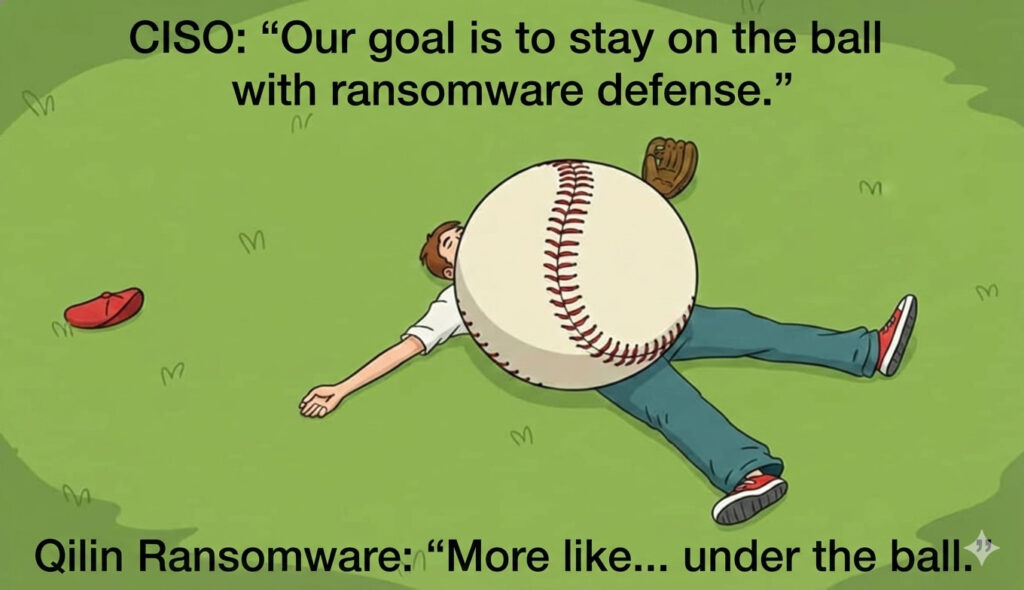
Most ransomware hits like a sledgehammer—loud, destructive, and immediate. Qilin is the saboteur who cuts your brake lines and drains the fire extinguishers before you even realize they’re in the building.
By the time the first alert pings, your backups are dead, your virtual core is severed, and your sensitive data is already on its way to a leak site. In 2026, “staying on the ball” isn’t enough; if you aren’t hunting for the subtle footprints of a Qilin intrusion, you’re already buried under it.
Why is Qilin Ransomware So Dangerous?
Qilin is a methodical, affiliate-driven machine that prioritizes high-value industries like healthcare, finance, and manufacturing. What makes it truly terrifying?
- The multi-language approach: Qilin is written in Rust and Go, making it highly efficient at attacking both Windows and Linux environments.
- The double extortion model: They don’t just lock your doors; they steal the jewelry. They exfiltrate sensitive data to their Tor-hosted leak site to pressure you into paying.
- Surgical precision: They use advanced encryption standards (AES-256-CTR) and have specific “reconnaissance modes” built into their binaries to adjust the impact before the final blow.
How a Qilin Ransomware Response Playbook Can Help
When the alert hits at 3:00 AM, the last thing you want is a room full of people asking, “So, what now?” A Qilin-specific playbook replaces panic with a checklist.
Here are a few lessons from our Qilin Response Playbook:
Lesson 1: Credentials are the keys to the kingdom.
Qilin almost always starts with a compromised VPN or RDP account. If your response doesn’t involve an immediate, organization-wide credential reset, you’re just inviting them back for round two.
Lesson 2: Speed wins, but forensics tells the story.
Qilin’s multi-threaded encryption is fast. They spawn a thread per file to maximize damage. You should prioritize memory snapshots (using tools like WinPMEM) before you start isolating systems to catch the in-memory loaders and RSA keys.
Lesson 3: Shield your virtual core.
Qilin variants are “virtually” obsessed, specifically targeting VMware infrastructure like vmware-vpxa and veeam to kill your recovery options before they even start encrypting. A playbook ensures you isolate your ESXi hosts and vCenter servers into secure VLANs the moment a breach is suspected.
Lesson 4: Native tools are the new malware.
Qilin loves using legitimate PowerShell and JS scripts to fetch their loaders and bypass traditional antivirus software. A playbook shifts your focus from looking for viruses to monitoring for behavioral anomalies, like a server suddenly launching an EncodedCommand at midnight.
Make your security stack Qilin-efficient
Avoid blind spots caused by misconfigured security stack.
Qilin Use Cases and Challenges: When Backups Aren’t Enough
Qilin’s playbook is designed to get around traditional safety nets by focusing on sectors where downtime isn’t just expensive, but legally catastrophic.
Here is how Qilin creates a dead-end scenario for unprepared teams:
- The Trojanized bait
Qilin often bypasses perimeter defenses by tricking your own users into doing the hacker’s job. A common use case involves spear-phishing campaigns delivering trojanized installers for legitimate tools like RVTools. To a busy admin, it looks like a routine utility update.
- The BYOVD
One of the greatest challenges for SOC engineers is Qilin’s use of the Bring Your Own Vulnerable Driver (BYOVD) technique. They deploy legitimate but vulnerable third-party drivers, like those from Zemana AntiMalware, to gain kernel-level access and systematically undermine your EDR or antivirus software. If your security tools are blinded from the inside out, they can’t alert you to the encryption until it’s finished.
- The public extortion pressure
Since Qilin prioritizes high-value industries like healthcare, finance, and legal sectors, they know your data is sensitive. Their double extortion model means that even if you restore every single byte from a backup, they still hold your data on their Tor-hosted leak site. This turns a technical recovery into a legal and PR nightmare, often triggering strict GDPR or HIPAA 72-hour reporting windows the moment you prove exfiltration.
- Surgical reconnaissance
Qilin binaries often include a –dry-run switch. This allows attackers to rehearse and see which files will be impacted and how long it will take before they pull the trigger. This level of calculation makes them far more efficient than older, more chaotic ransomware strains.
Enhance Your Ransomware Hit Readiness
Resource Demands and Hidden Costs
Building a defense against Qilin requires an investment that goes beyond the price of a license:
- Security tooling: You need MDR and SOAR platforms capable of behavioral detection, not just file scanning.
- Compliance & legal: Since Qilin steals data, you are often under a 72-hour clock (like GDPR) to report the breach. The cost of legal counsel to navigate OFAC and UK sanctions regarding ransom payments is a “hidden” expense many forget.
- Operational burnout: Tuning alerts for Qilin-style lateral movement can lead to alert fatigue if not handled by a dedicated SOC.
How UnderDefense Helps: Your 24/7 Defense Against Qilin
At UnderDefense, we don’t just watch for the Qilin, we hunt it. Our MAXI AI platform provides continuous, expert-backed monitoring needed to catch the subtle signs of a Qilin intrusion before the encryption phase begins.
Our 24/7 team offers:
- Real-time monitoring
We spot the anomalous RDP logins and suspicious PowerShell commands that precede an attack. - Rapid containment
We help you rotate credentials and isolate infected hosts (like those pesky compromised ESXi servers) within minutes, not hours. - Forensic preservation
We ensure that when you recover, you do so without leaving backdoors open for the attackers to use later.
1. How do I know if I'm hit by Qilin?
Look for file extensions like .qilin, .agenda, or .gQ_UbazLFd and ransom notes titled README.txt.
2. Should I pay the ransom?
The FBI discourages it. The ransom funds future crime and doesn’t guarantee your data will be deleted from their leak site.
3. How does Qilin get in?
Mostly through phishing and compromised remote access (VPN/RDP).
4. Can Qilin ransomware kill my backups?
Yes. They specifically target processes like Veeam and MySQL to prevent you from restoring without them.
The post Qilin Is Your New Biggest Problem: How To Prepare? appeared first on UnderDefense.